
Astrophyzix Digital Observatory – Technical User Guide
Astrophyzix Digital Observatory – Technical User Guide
The Astrophyzix Digital Observatory is an open-access space science platform designed to provide real-time access to astronomical data streams, planetary defence monitoring tools, and interactive orbital visualisation systems. The observatory integrates multiple scientific modules into a unified web-based environment, allowing users to explore datasets commonly used by professional space agencies and research institutions.
The platform is designed to support science communication, astronomy education, and open data exploration by presenting institutional datasets through simplified analytical interfaces. While the observatory does not generate independent observational data, it provides structured access to publicly available datasets produced by international scientific organisations.
This document provides a technical overview of the observatory architecture and describes the operational purpose of each module currently implemented within the Astrophyzix platform.
Platform Architecture
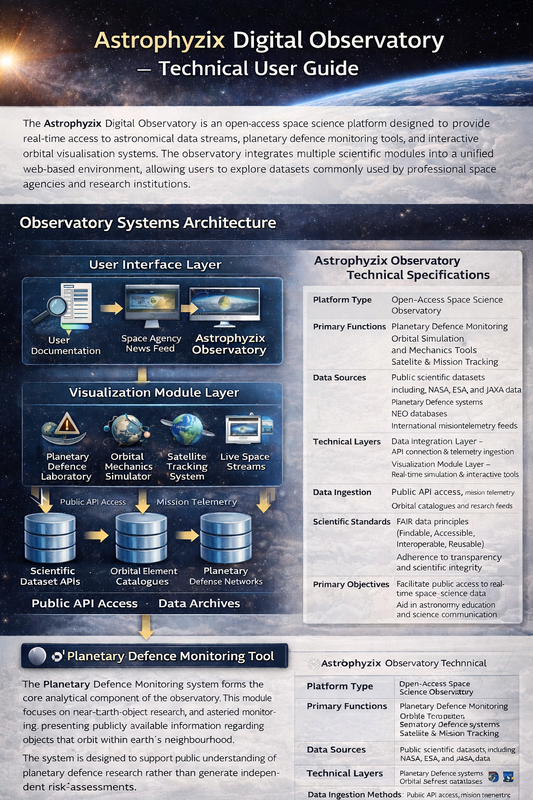
The Astrophyzix Digital Observatory operates as a modular web-based research interface. Each scientific tool is implemented as a self-contained module that interacts with external data sources and visualisation frameworks. This modular architecture allows new analytical tools and data visualisations to be integrated without disrupting existing systems.
The platform architecture consists of three primary components:
- Data ingestion layer
- Scientific visualisation modules
- User interface and documentation framework
External datasets are accessed through public institutional APIs, published data archives, or embedded mission resources. These datasets are then presented within interactive visualisations designed for educational exploration and scientific interpretation.
Data Integration Framework
Astrophyzix modules rely on publicly available datasets published by space agencies, planetary defence monitoring systems, and scientific institutions. Data sources may include orbital element catalogues, spacecraft telemetry feeds, mission media streams, and observational datasets.
The platform does not modify or reinterpret primary datasets. Instead, the system acts as an aggregation and visualisation layer that presents scientific information through simplified interactive interfaces.
Typical data integration methods include:
- Public API access to institutional datasets
- Embedded mission telemetry and video streams
- Orbital element catalogue integration
- Space agency news and research feeds
All modules are designed to maintain transparency regarding the origin of the datasets displayed within the observatory environment.
Planetary Defence Monitoring System
The Planetary Defence Monitoring System forms the core analytical component of the observatory. This module focuses on near-Earth object research and asteroid monitoring, presenting publicly available information regarding objects that orbit within Earth's neighbourhood.
The module provides access to asteroid discovery data, orbital classifications, and general physical characteristics derived from observational astronomy. Users can explore asteroid profiles and gain insight into how astronomers categorise near-Earth objects.
The system is designed to support public understanding of planetary defence research rather than generate independent risk assessments.
- Near-Earth object catalogue exploration
- Asteroid classification reference tools
- Orbital parameter summaries
- Access to official scientific resources
Near-Earth Object Data Visualisation
The NEO monitoring module provides a simplified visual interface for exploring asteroid orbital characteristics. The system displays parameters commonly used by planetary scientists, including orbital period, approximate size estimates, and close-approach distances.
The purpose of this module is to translate complex orbital datasets into a format accessible to both educational users and science communicators.
Objects displayed within the module are sourced from recognised astronomical catalogues and updated as new observational data becomes available.
Solar System Orbital Mechanics Simulator
The Solar System Orbital Modelling module is an interactive simulation designed to demonstrate the gravitational dynamics governing planetary motion. The simulation visualises orbital paths within the Solar System and allows users to observe the relative motion of planets around the Sun.
Although simplified, the simulation illustrates key principles of celestial mechanics including orbital period relationships, gravitational influence, and long-term orbital stability.
The module is primarily intended for educational exploration and conceptual understanding rather than high-precision astrophysical modelling.
- Planetary orbital visualisation
- Relative orbital speed comparison
- Gravitational interaction demonstration
- Orbital scale interpretation
Orbital Resonance Explorer
Orbital resonance occurs when orbiting bodies exert periodic gravitational influence on each other due to specific ratios between their orbital periods. This phenomenon plays an important role in shaping planetary systems and stabilising orbital configurations.
The Orbital Resonance Explorer module demonstrates these interactions through animated simulations. The visualisation helps users understand how gravitational coupling between orbiting bodies produces stable resonance patterns.
Examples of orbital resonance within the Solar System include the orbital relationships among Jupiter’s Galilean moons and the resonance between Neptune and Pluto.
Satellite Tracking Interface
The satellite tracking module provides real-time visualisation of spacecraft orbits around Earth. Using publicly available orbital elements, the system calculates satellite positions and displays their ground tracks relative to Earth's surface.
The tracking interface allows users to observe how satellites move across the planet as they complete their orbits.
- Orbital ground track visualisation
- Real-time spacecraft positioning
- Orbital inclination representation
- Low Earth orbit tracking
This module offers a simplified demonstration of orbital mechanics within Earth's immediate space environment.
International Space Station Earth Observation Stream
The ISS Earth observation module provides a continuous live video stream from cameras mounted on the International Space Station. This stream allows users to observe Earth from low Earth orbit as the station travels around the planet approximately every ninety minutes.
The video feed offers a unique perspective on atmospheric dynamics, cloud formations, and the changing illumination of Earth's surface during orbital day-night cycles.
Live Space Agency News System
The live news module aggregates research announcements and mission updates published by space agencies and scientific organisations. The feed automatically refreshes to ensure that users have access to the latest developments in space exploration and astronomy research.
Typical content displayed includes mission launches, planetary science discoveries, spacecraft operations updates, and new observational findings.
Scientific Documentation Framework
Many modules within the observatory include collapsible documentation panels that provide contextual scientific explanations. These documentation sections describe the underlying physical processes, observational methods, and research concepts relevant to each module.
This framework allows users to move seamlessly between interactive exploration and educational background information.
System Design Principles
- Transparency of data sources
- Accessibility of scientific information
- Modular architecture for future expansion
- Responsiveness across desktop and mobile platforms
- Educational integration of data and explanation
Future Observatory Expansion
The Astrophyzix platform is designed to evolve as new scientific datasets and technologies become available. Future development plans include additional planetary monitoring tools, enhanced orbital modelling capabilities, and expanded integration of observational astronomy datasets.
Conclusion
The Astrophyzix Digital Observatory represents an effort to bridge the gap between professional scientific datasets and public accessibility. By combining real-time observational tools, orbital simulations, and structured documentation, the platform provides a unique environment for exploring modern space science.
As the observatory continues to expand, it aims to support science communication, public education, and open exploration of the dynamic processes that govern our Solar System.